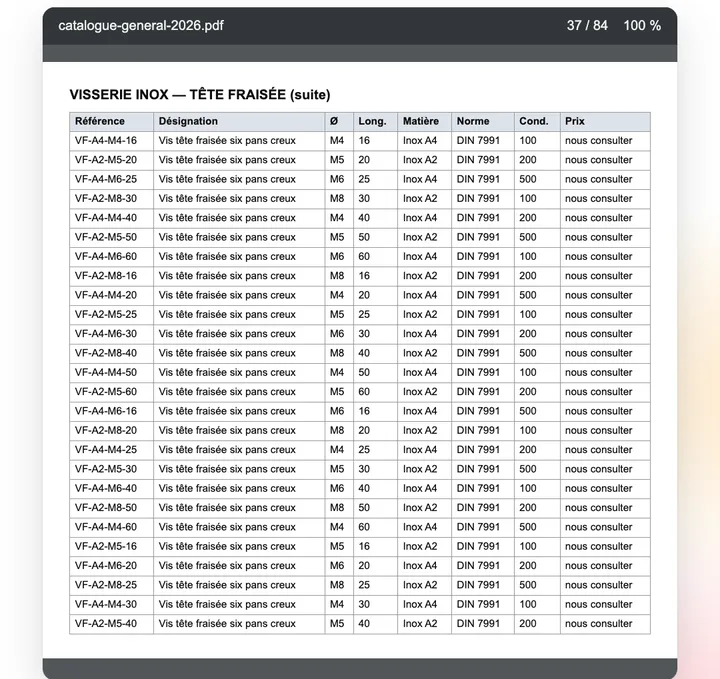
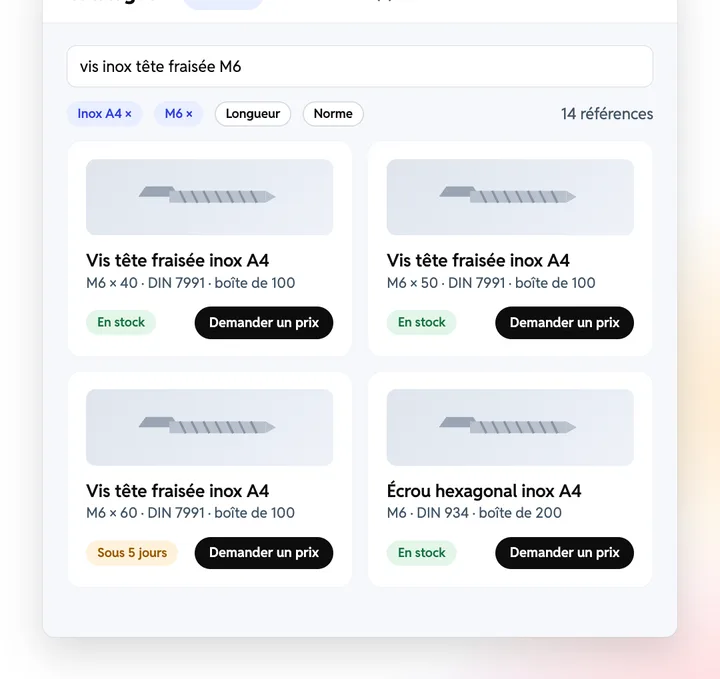
A catalogue people can search

We integrate the best headless CMS (Strapi, Sanity, Contentful) to offer you flexible, high-performance content management decoupled from your front-end.
Develop my project





Traditional CMS quickly reach their limits in terms of performance, security and integrations. With a headless CMS, you completely separate content from the front-end for a modern architecture that combines performance, editing simplicity and total front-end freedom.
We build websites with headless CMS (Sanity, Directus...), connected to an ultra-fast front-end (Next.js). The result: a site that loads fast, connects to your existing tools, and stays easy to maintain over time.
Choosing between Sanity, Directus or Strapi depends on your context: Sanity shines on rich editorial sites with a highly customisable studio, Directus fits when you want to drive existing business data alongside content, Strapi offers a good balance when tech teams want to own everything. We make the call during project scoping based on content volumes and editor profiles.
A headless site exposes APIs that can feed multiple channels: public website, mobile app, newsletters, in-store screens. This decoupled logic also lets you rebuild an existing site progressively rather than from scratch, in the spirit of a controlled application modernisation.
The result: a smooth, secure, easy-to-manage site — built to last.
Situations we come across often, and the tool we can make of them.
Your content types are modelled in workshops with your editorial teams, before the first line of code.
Sanity, Directus or Strapi: we decide during scoping, based on your volumes and editor profiles.
Each editor only sees the fields and validation steps that concern their scope.
REST or GraphQL APIs come documented so your tech teams can plug in without us.
No third-party plugin to maintain on the front: the classic coupled-CMS weak spot disappears.
A Next.js front served from a CDN, including multi-language sites with large catalogues.
An existing site can migrate template by template, instead of switching over in one day.
You keep the front-end code, with no imposed theme and no vendor lock-in.
Concrete custom development achievements
Identify levers to strengthen farm autonomy
An extranet to centralize all information and documentary resources
Offer a mortgage simulation that matches real lending conditions
Provide tools to master energy consumption
Carry out genomic sequencing projects
Identify levers to strengthen farm autonomy
An extranet to centralize all information and documentary resources
Offer a mortgage simulation that matches real lending conditions
Provide tools to master energy consumption
Carry out genomic sequencing projects
Identify levers to strengthen farm autonomy
An extranet to centralize all information and documentary resources
Offer a mortgage simulation that matches real lending conditions
Provide tools to master energy consumption
Carry out genomic sequencing projects
We analyze your content types, their relationships and publication workflows. This is the step that determines everything: a good data model ensures a smooth editorial experience and performant APIs for your front-ends. This work usually starts during project scoping, in workshops with editorial teams.
We configure the CMS to exactly match your needs: custom fields, roles and permissions, validation workflows, webhooks and third-party integrations. The admin interface is adapted to each user profile. On Sanity as on Directus, the studio can be extended with custom components to match your real editorial templates.
Thanks to the Headless architecture, your content is accessible via REST or GraphQL APIs. You can simultaneously feed your website, mobile app, newsletters and any other channel from a single source of truth. The exposed APIs are documented so your tech teams or external partners can plug in quickly.
The budget depends on the number of content types, languages, validation workflows and IS integrations. Licence costs vary across CMS (Sanity, Directus, Strapi), and we pick the language and tech stack based on your existing codebase. The free first scoping gives you a first range for your case, with no commitment.
For a standard editorial site, expect 8 to 14 weeks between the first workshop and go-live. We start with content modelling and the front for one or two template pages in Next.js, then extend to the other templates in parallel with editorial filling. Complex sites (multi-site, multi-language, portals) rather require 4 to 6 months with a progressive MVP approach.
WordPress and Drupal are coupled CMS: front and back-office live in the same application. That's fast to start but limits performance and flexibility on large sites. A headless CMS (Sanity, Directus, Strapi) separates content from rendering: you gain speed, security and can distribute the same content across multiple channels without duplicating input. The trade-off: a front to build in React or Next.js instead of picking an off-the-shelf theme.
A Headless CMS frees you from the constraints of traditional CMS. No more rigid templates, no more plugins to maintain, no more security vulnerabilities from obsolete extensions. You keep total control over your front-end.
Your editorial teams work in an interface designed for them, while your developers use modern technologies of their choice: React, Vue, Next.js, Nuxt, or even native mobile apps.
The separation between content and presentation also facilitates evolution: you can redesign your site without touching the CMS, or add new distribution channels without modifying your editorial organization.
What our clients appreciate about their Headless CMS:
Describe it in a few lines: you get a first reading of the need, the points to decide and a budget range.