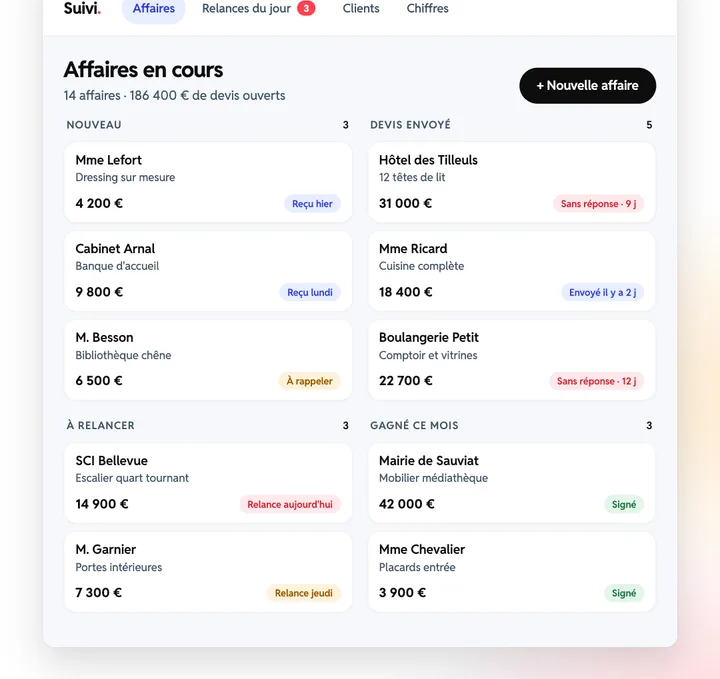
A CRM your team opens every morning
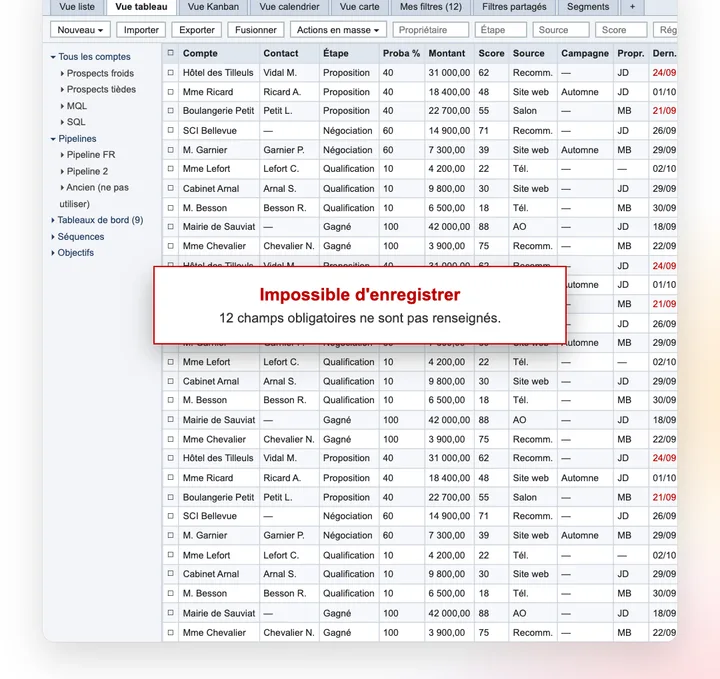

Your application is slow, ageing or blocking your evolutions? We rebuild it on a modern stack, progressively and without service interruption. Audit, migration plan, controlled rewrite.
Request an audit







A sluggish application, a technology that is no longer maintained, changes that take longer and longer to ship: at some point, patching is no longer enough and technical debt ends up slowing everything down. A rebuild means reconstructing your application on solid foundations, while keeping what makes its value — your data and your business logic.
We always start with an audit: what is worth keeping, what must be rewritten, the security flaws to fix, and above all in what order. You leave with a costed migration plan, not a promise of a clean slate.
The rebuild happens progressively, module by module, without cutting the service: your users keep working while the application modernises in the background. This is the so-called "strangler" approach, and we explain the choice between a full rewrite and progressive modernisation on our blog — the latter is almost always safer.
On the technical side, we rebuild on a modern, durable stack: Next.js and React for the interface, Django or Python on the back-end. Enough to last several years without piling up new debt.
If your code doesn't need a rebuild but simply needs to be taken over and maintained, that's a different service: see our code takeover. A rebuild changes the stack and the architecture — not just the maintainer.
Situations we come across often, and the tool we can make of them.
Old and new versions run side by side during the migration, with no single switch-over day.
The audit says what to keep, what to rewrite, and above all in what order.
Your database migration is validated by tests, history and references included.
Next.js and React for the interface, Django or Python on the server side.
It's the foundations that change, not the way your teams work.
The first batches reach production within the opening weeks of the rebuild.
Mainstream technologies, so your tool no longer depends on one single developer.
Outdated dependencies and flaws found during the audit are fixed as we rebuild.
Concrete custom development achievements
Identify levers to strengthen farm autonomy
An extranet to centralize all information and documentary resources
Offer a mortgage simulation that matches real lending conditions
Provide tools to master energy consumption
Carry out genomic sequencing projects
Identify levers to strengthen farm autonomy
An extranet to centralize all information and documentary resources
Offer a mortgage simulation that matches real lending conditions
Provide tools to master energy consumption
Carry out genomic sequencing projects
Identify levers to strengthen farm autonomy
An extranet to centralize all information and documentary resources
Offer a mortgage simulation that matches real lending conditions
Provide tools to master energy consumption
Carry out genomic sequencing projects
When the technology is no longer supported, when every change is costly and risks breaking everything, or when hiring for that stack becomes impossible. If the application is healthy but simply ageing, a code takeover is often enough: it is mainly the level of technical debt and the state of the architecture that tip the balance towards a rebuild.
We proceed module by module (strangler approach): we replace one part at a time, the old and new versions coexist, and the switch happens progressively. At no point are your users left without a tool.
Yes. Data migration is an integral part of the rebuild: we take over your existing database, clean it up if needed, and the migration is validated by automated tests. Your history and references stay intact.
A code takeover keeps the existing code and improves it. A rebuild keeps the idea and the data but changes the stack and architecture. A rewrite starts from scratch. We compare these options in full rewrite or progressive modernisation: a progressive rebuild is the best compromise, real modernisation without the risk of a "big bang" project.
It depends on the scope. We start with an audit that ends with a costed migration plan. A progressive rebuild is generally two to three times less risky than a full rewrite carried out in one go. The free first scoping gives you a first range for your case, with no commitment.
The audit and scoping take 2 to 4 weeks. The progressive rebuild then spans several months, delivered in regular batches: you see results within the first weeks. An upfront project scoping, backed by a clear requirements document, secures the scope and budget.
A progressive rebuild gives you back an application that is fast, secure and pleasant to use, without the trauma of a project that drags on or a risky switch-over.
On a modern stack, changes become simple and fast again: you ship new features in days rather than months, and hiring developers is no longer a headache.
And because we keep your data and your business logic, your teams are not lost: they find their bearings in a tool that is simply more modern and more reliable.
What you gain from a rebuild:
Describe it in a few lines: you get a first reading of the need, the points to decide and a budget range.